Epoxy vs Polyurea Garage Floor: Which Coating Is Better?
Choosing between epoxy and polyurea (polyaspartic) for your garage floor is one of the biggest decisions you will make in a coating project. Both products protect concrete, resist chemicals, and look great when properly applied. But they differ in cure time, cost, UV stability, and application difficulty. This guide breaks down every meaningful difference so you can pick the right coating for your garage, budget, and timeline.
Need a quick material estimate before you decide? Try the epoxy floor calculator to see how much coating you need for your space.
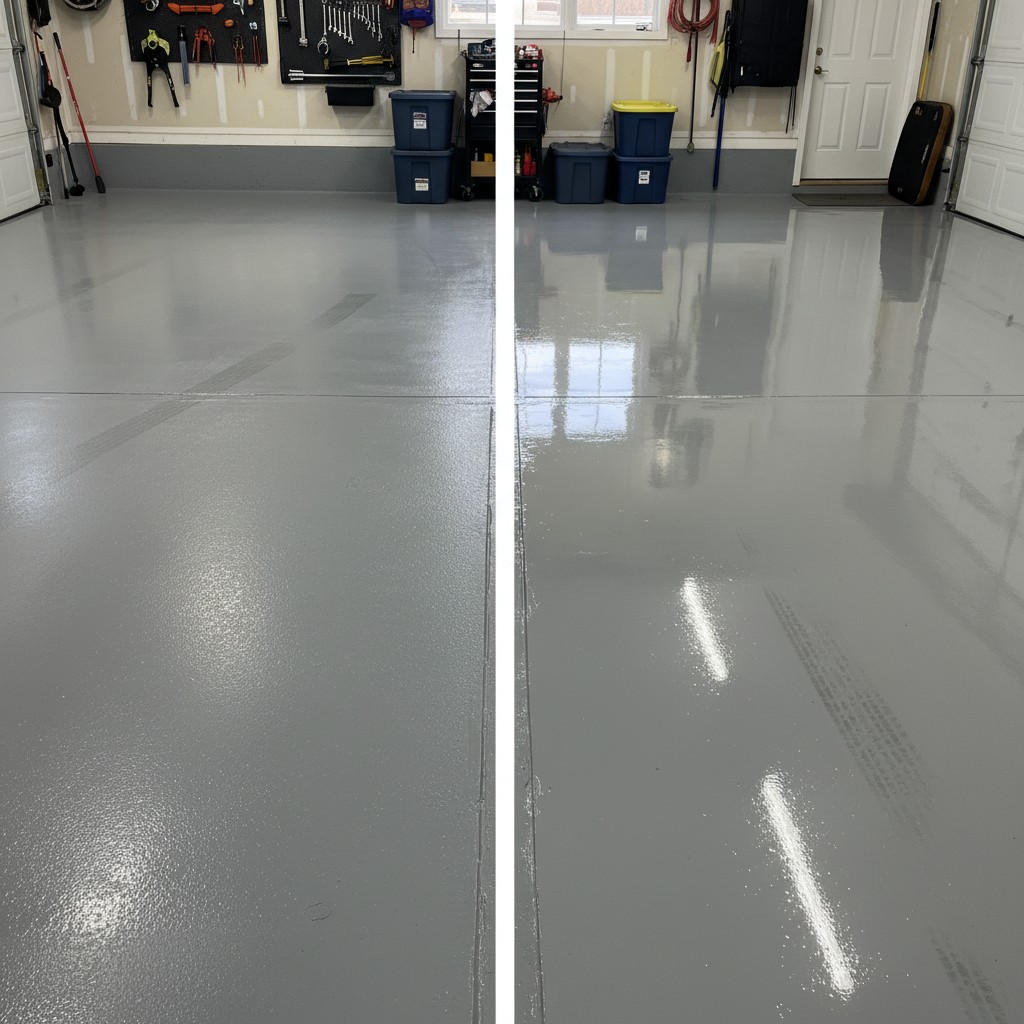
What Is Epoxy Floor Coating?
Epoxy floor coating is a two-part system consisting of a resin and a hardener. When mixed together, they trigger a chemical reaction (called an exothermic cure) that creates an extremely hard, bonded surface on top of your concrete. This is fundamentally different from paint, which simply sits on the surface and relies on mechanical adhesion alone.
The curing process for epoxy typically takes 72 hours before you can walk on it and 5-7 days before you should park vehicles on it. During this time, the coating cross-links at the molecular level, building a rigid, chemical-resistant film that can handle decades of abuse in a residential garage.
Pros of epoxy:
- Affordable — DIY kits start around $80 for a 1-car garage, making it the most budget-friendly professional-grade option
- DIY-friendly — Longer pot life (45-60 minutes) gives beginners more working time to spread the coating evenly
- Thick film build — 100% solids epoxy can achieve 8-12 mils per coat, building a substantial protective layer
- Excellent adhesion — When properly prepped, epoxy bonds tenaciously to concrete and resists peeling
- Chemical resistant — Stands up to gasoline, oil, brake fluid, and most household chemicals
- Wide product range — From budget water-based to professional 100% solids, there is an epoxy for every budget
Cons of epoxy:
- Yellowing — Most epoxies amber over time when exposed to UV light, especially near garage doors
- Long cure — 72 hours to walk, 5-7 days before driving on it
- Hot tire pickup — Some epoxies (especially water-based) can peel when hot tires sit on them
- Temperature sensitive — Must be applied between 50-90°F with concrete temperature above 55°F
What Is Polyurea (Polyaspartic) Coating?
Polyurea and polyaspartic coatings are part of the same chemical family. Polyaspartic is technically a subset of polyurea chemistry, and in the garage floor world, the terms are often used interchangeably. These coatings also use a two-part chemistry (resin and catalyst), but the reaction is significantly faster, and the resulting film has different performance characteristics than epoxy.
The defining advantage of polyurea is speed. Most polyaspartic garage floor systems can be applied and returned to foot traffic in 4-6 hours. You can park on them within 24 hours. This is the primary reason professional installers like 1-Day Garage Floor and similar franchises have standardized on polyurea/polyaspartic systems.
Pros of polyurea:
- UV stable — Will not yellow or amber, even in south-facing garages with constant sun exposure
- Same-day cure — Walk in 4-6 hours, drive in 24 hours
- No hot tire pickup — Polyaspartic coatings resist tire marks and peeling from hot tires
- Wide temperature range — Can be applied in temperatures from 30°F to 100°F
- Superior abrasion resistance — Harder, more flexible film resists scratches and scuffs
- Longer lifespan — 15-20+ years with proper prep
Cons of polyurea:
- Higher cost — Materials alone are 2-3x the price of comparable epoxy products
- Thinner film — Single coats build less thickness than 100% solids epoxy
- Fast pot life — Only 15-25 minutes of working time, demanding quick, experienced application
- Harder DIY — The fast cure leaves little room for mistakes or slow rolling technique
Side-by-Side Comparison Table
| Feature | Epoxy | Polyurea / Polyaspartic |
|---|---|---|
| Cost per sq ft (DIY) | $2 - $4 | $5 - $8 |
| Cure Time (walk) | 24-72 hours | 4-6 hours |
| Cure Time (drive) | 5-7 days | 24 hours |
| Durability | Good to Excellent | Excellent |
| UV Resistance | Poor — yellows over time | Excellent — no yellowing |
| Hot Tire Pickup | Moderate risk (water-based) | No risk |
| Application Difficulty | Beginner-friendly | Intermediate to advanced |
| Lifespan | 5-10 years (standard), 10-15 (100% solids) | 15-20+ years |
| Working Time (pot life) | 45-60 minutes | 15-25 minutes |
When to Choose Epoxy
Epoxy is the right call when budget matters and you can spare the cure time. If you are a first-time DIYer tackling your garage floor as a weekend project, the forgiving pot life of epoxy gives you breathing room to work methodically. You will not feel rushed, and small mistakes like uneven roller passes can be corrected before the material sets.
Epoxy also makes sense for moderate-use garages. If your garage primarily stores vehicles and lawn equipment — with no extreme temperature swings or direct UV bombardment — a quality 2-part epoxy with a clear top coat will perform beautifully for 7-10 years or longer. The best garage floor epoxy kits in the mid-range category offer excellent value for this use case.
Choose epoxy when:
- Your budget is under $400 for a 2-car garage (DIY)
- You can keep the garage clear for 5-7 days while it cures
- This is your first time applying a floor coating
- The garage does not get extended direct sunlight
- You want the thickest possible film build for maximum protection
When to Choose Polyurea
Polyurea shines when downtime is unacceptable or UV exposure is a concern. If you live in a southern climate where your garage door is open frequently, or your garage faces south and gets hours of direct sun, epoxy will yellow noticeably within 1-2 years. Polyurea stays crystal clear indefinitely.
The same-day return to service is genuinely transformative for people who cannot afford to park in the driveway for a week. This is especially important in climates with rain, snow, or extreme heat where leaving vehicles outside for days is impractical. A polyaspartic system applied in the morning can accept foot traffic by evening and vehicles by the next day.
For a deeper look at polyaspartic specifically, see our polyaspartic garage floor coating guide.
Choose polyurea when:
- You need the floor back in service within 24 hours
- The garage gets significant UV/sun exposure
- Hot tire pickup resistance is a priority
- You have experience with fast-cure coatings or are comfortable with the speed
- Long-term value matters more than upfront cost
Can You Combine Them?
Yes, and many professional installers consider a hybrid system the gold standard. The most common approach is an epoxy base coat topped with a polyurea or polyaspartic clear coat. This combines the strengths of both chemistries while minimizing their weaknesses.
The epoxy base coat provides affordable, thick coverage with excellent adhesion to the concrete. It builds the primary protective layer and is where decorative flake chips are broadcast. The polyaspartic top coat then seals everything with a UV-stable, abrasion-resistant clear layer that prevents yellowing and resists hot tire pickup.
This hybrid approach costs less than a full polyurea system while delivering comparable performance. For a 2-car garage, expect materials to run $400-700 DIY — more than straight epoxy but significantly less than going all-polyurea. Many professional franchise operations use exactly this system, applying an epoxy primer, an epoxy color/flake coat, and a polyaspartic clear top coat.
Cost Comparison by Garage Size
These estimates include all materials: primer, base coat, decorative flake, and top coat. Professional prices include labor. Use the epoxy floor calculator to get a precise material estimate for your exact dimensions.
| Garage Size | DIY Epoxy | DIY Polyurea | Pro Epoxy | Pro Polyurea |
|---|---|---|---|---|
| 1-Car (240 sq ft) | $150 - $350 | $400 - $700 | $960 - $2,400 | $1,920 - $3,600 |
| 2-Car (400 sq ft) | $250 - $550 | $650 - $1,100 | $1,600 - $4,000 | $3,200 - $6,000 |
| 3-Car (600 sq ft) | $350 - $800 | $900 - $1,600 | $2,400 - $6,000 | $4,800 - $9,000 |
For a detailed breakdown of every cost component, see our full garage floor epoxy cost guide. It covers hidden costs like concrete repair, tool rental, and moisture mitigation that most estimates leave out.
Related Reading
- Epoxy Floor Calculator — Get precise material quantities for your project
- Garage Floor Epoxy Cost Guide — Full 2026 pricing breakdown
- Best Garage Floor Epoxy Kits — Top products compared
- Polyaspartic Garage Floor Coating Guide — Deep dive on polyurea/polyaspartic systems